Did you try looking up something on Google and wonder why certain websites get listed on the first page and others get listed page after page on Google? Here is where the need of Search Engine Optimization or SEO arises.
Table of Contents
What is Search Engine Optimization ?
Search Engine Optimization (SEO) is the process by which one optimizes their website in order to have a higher ranking on search engines such as Google and make it easy for customers to reach them while looking up for products/services or even information. SEO is one of the most important things in digital marketing due to its significance of visibility in the internet world.
But SEO is not simply writing some keywords in your website and hoping that Google will notice it. SEO involves improving a lot of things about your website.
Who Can Benefit from SEO?
Another popular myth surrounding SEO is that it is not something that small or medium-sized businesses can take advantage of, since SEO requires big websites and significant marketing budgets. In truth, however, any individual or company that operates an online presence could benefit from SEO.
Businesses
If you are the owner of a local company or one of those that are growing rapidly, SEO can help you get discovered by prospective customers through the Internet.
eCommerce Stores
For eCommerce businesses, SEO can assist you in making sure that pages containing particular products and/or product categories will be shown when people are searching for products.
Bloggers & Content Creators
Blog and content creators benefit from using SEO by attracting the attention of people who are actually looking for information on the topics covered by your content rather than relying solely on social media for traffic.
Marketing Agencies
SEO can be considered one of the key services provided by any marketing agency. Agencies use seo strategies to help their clients to attract organic traffic and improve visibility
How Do Search Engines Work?
Before understanding how to improve SEO, it helps to know what actually happens when you publish a webpage.
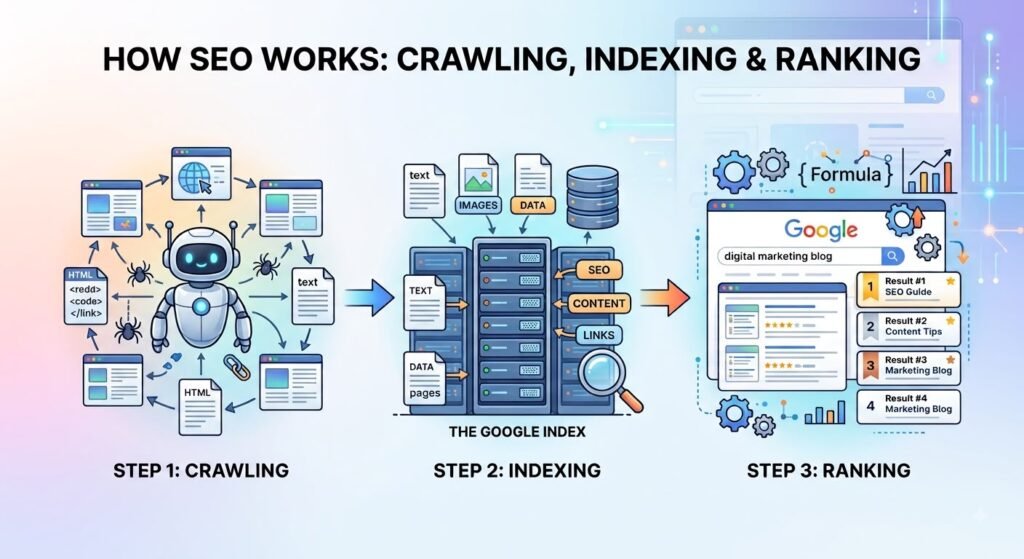
Search engines generally follow a three-step process:
1. Crawling
Search engines have bots known as spiders or crawlers to help locate the new and changed content all over the internet.
The crawlers travel from page to page through links and gather information about each page that is located.
2. Indexing
Once the page is crawled, its information is included into a very big database called an index.
The search engines analyze the information in order to understand what the page is about, e.g., the page’s content, keywords, structure, etc.
If your page is not indexed by the search engines, it has almost no chances to show up in the results.
3. Ranking
When someone makes a search, the search engines check the index for those pages that would be more relevant and useful for the given search query.
The ranking can depend on hundreds of factors, such as content, backlinks, user experience, relevancy, and website factors.
That is why publishing alone cannot help a page rank high in Google.
The Three Pillars of SEO
To improve visibility, attract quality traffic, and support conversions, your strategy can be divided into three major areas:
- On-Page SEO
- Off-Page SEO
- Technical SEO
1. On-Page SEO
On-page SEO revolves around optimization of components within your website and content.
They include:
- Relevant use of keywords
- Creation of valuable and unique content
- Optimization of title and description tags
- Proper use of heading tags
- Descriptive image alt text
- Optimizing internal links
- Ensuring readability
- Search intent match
For instance, when writing a blog post about SEO marketing, it would be clear from your title tag, headings, introduction, and content itself that the article is all about SEO marketing. Meanwhile, the keyword should be used naturally, without being used in all of your sentences.
This is not about creating something for Google alone. You have to create it first for the reader, and only then think about how it will be recognized by search engines.
Benefits of On-Page SEO
- Enhances search relevance: Assists search engines in understanding the topic of the page.
- Increases usability: Headings, readable content, information, and proper page organization increase usability of the pages.
- Appeals to relevant searches: Keyword and search intent optimization enables targeting the right audience.
- Improves internal linking: Internal links assist in finding related pages on the website.
- Facilitates understanding of content: Properly organized pages become easy to comprehend by users and search engines.
2. Off-Page SEO
Off-page SEO comprises actions that take place away from your site but could contribute to increasing the authority and visibility of your website.
The most common one is backlink building. Backlink refers to links pointing from other sites to your site.
Some of the other off-page actions may include:
- Guest posting
- Article submission
- Digital PR
- Brand mention
- Social media sharing
- Community building
- Local business listing when relevant
However, it should be noted that all backlinks are not equal.
Randomly acquiring backlinks from irrelevant or low-quality sites simply to boost the backlink count is not an effective SEO tactic.
Benefits of Off-Page SEO
- Boosts website authority: Good quality backlinks and mentions will help build the reputation of your website.
- Brand awareness: You may get discovered on other websites apart from your own.
- Helps in referral traffic: Traffic can flow through you through links from other related websites.
- Credibility: Getting mentioned by trustworthy sites will help improve the reputation of your brand.
- Online presence: Off-page activities will help you get discovered through your website.
3. Technical SEO
Technical SEO involves technical factors of your website that will help search engines crawl and index your website.
Some of the most important areas are:
- Website speed and performance
- Mobile-friendly
- XML sitemap
- Robots.txt
- Website security
- Proper URL structure
- Crawlability
- Indexing
- Structured data or schema markup
- Broken link and technical issues
Benefits of Technical SEO
- Increases crawlability: Allows search engines to visit and comprehend your website.
- Increases indexing ability: A website that is well-structured and technically correct will allow search engines to index your pages effectively.
- Improves user experience: Performance and usability improve user experience.
- Avoids technical issues: Resolving broken links and any other issues helps maintain a healthy website.
- Builds a solid base for SEO: Even quality content will be unable to function without a technically correct website.
It is not necessary to know programming in order to do technical SEO. SEO plugins and Google Search Console are some of the tools that can help simplify the process.
Benefits of SEO in Digital Marketing
1. Helps Increase Organic Visibility
Through SEO, your site can become visible in search engine results whenever individuals are actively searching for subjects, products, or services similar to those offered by your business.
2. Helps Generate Relevant Traffic
When compared to reaching out to individuals randomly through advertising, it is possible that search traffic will come from individuals who are actively interested as evidenced by the search terms used by them.
This means that an individual actively searching for “best digital marketing course for beginners” is likely more serious than one randomly exposed to a digital marketing ad while browsing.
3. Improves Trust and Credibility
Individuals often link visibility in search results with credibility, especially when a website provides useful and trustworthy information consistently.
The process of establishing trustworthiness through content creation and authority building can help in this.
4. Contributes to Sustainable Growth
With paid advertising, you can attract traffic only so long as you pay for it. This is not true of SEO. One piece of properly optimized content continues to attract organic traffic long after its publication.
However, SEO is not entirely passive since search results and competition change continuously.
5. Understands the Audience
In addition to getting better rankings, SEO can give you insight into what the audience is searching for, what kind of questions they are asking, and what their issues are.
This can be very helpful in creating more effective marketing campaigns and products.
6. Assists with Conversion
Of course, getting more traffic is not the only aim of SEO. Once users come to your website, an efficient SEO strategy must also assist them in finding the necessary information and taking actions.
It may be signing up for a newsletter, buying some products, contacting customer support, etc.
SEO Is a Continuous Effort. Another thing to know about SEO is that it usually does not yield immediate results.
Even if you publish an article today and do everything right in terms of optimization, there is no guarantee that it will get top ranking tomorrow.
Search engines need time to index pages while the website itself needs to gain more relevance and authority.
The best thing to do is to keep improving your website through creating more valuable content and monitoring performance.
Final Thoughts
Search engine optimization is one of the key components of digital marketing, which ensures that websites are easy to locate by potential customers who are looking for specific information, goods or services.
Different aspects of SEO such as on-page SEO, off-page SEO and technical SEO have their own functions, which are combined to ensure better visibility, attracting of target visitors and increasing credibility of the website to achieve business growth.
When you are a beginner in the field of SEO, you should not be intimidated by the huge amount of information available. To start with SEO, all you need is to understand the needs of your potential customers, conduct keyword research, produce valuable content and ensure that the website is user-friendly.
A good SEO strategy does not involve making Google rank your website; it means providing people with a reason to prefer your page.
Want to explore more about digital marketing? Visit my website for more helpful guides, tips, and insights.