Email marketing is one of the integral components of digital marketing which enables organizations to interact with the target audience via email. Emails can be sent for different purposes, such as informing, advertising products and/or services, building customer relationships, nurturing leads, and driving conversions.
Newsletters, automated emails, and promotional campaigns are just some examples of different types of emails that businesses can utilize in order to achieve certain marketing goals. If properly planned, email marketing can assist organizations to develop relationships with the customers, increase awareness about their brands, generate traffic to websites, and boost sales.
Table of Contents
What is Email Marketing?
Email marketing is a type of digital marketing in which organizations send emails to those who subscribe to their mailing list or give their permission to send the emails. In these emails, businesses can share information, advertise their products/services, distribute content, nurture leads, and build relationships with customers.
While some methods of advertising include the reach of the customers via third-party channels, email marketing allows organizations to establish communication with subscribers via their inboxes.
For instance, an online clothing store might send a welcome email to its new subscriber, followed by product recommendations, promotional campaigns, or announcement about a new collection.
Why Is Email Marketing Important?
Email marketing enables businesses to establish continuous communication with interested people regarding their brand. Email marketing can be applied at various stages of a client’s journey, ranging from introduction of the brand to lead nurturing and conversion into returning clients.
Some reasons why businesses conduct email marketing include the following:
1. Build Relationship With Customers
Continuous and relevant communication can help businesses to stay connected with their customers and establish a relationship.
2. Increase Brand Awareness
Continuous emails can keep the brand at the forefront of their minds.
3. Increase Website Traffic
Emails can be used by businesses to guide their clients to blog posts, product pages, landing pages, and other useful links.
4. Lead Generation and Nurturing
Email campaigns can supply valuable information to the potential customer and slowly convert them to make a purchase.
5. Promoting the Products and Services of Business
Businesses can announce the release of new products, services, and discounts through emails.
6. Personalization of Communication
Email marketing helps businesses to personalize their communication with their audience segments based on various factors.
Types of Email Marketing
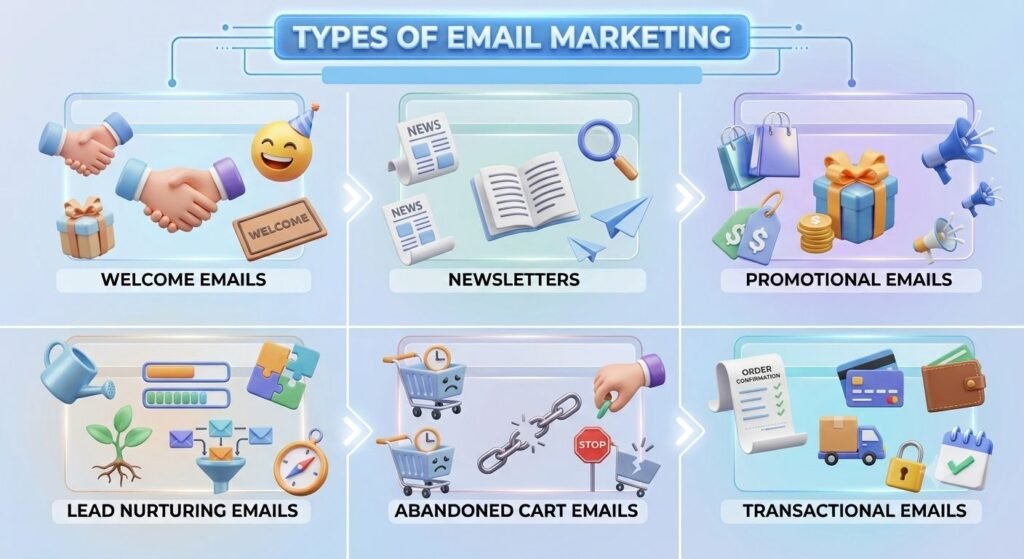
Emails have various functions depending on their types. Selection of the type should be based on the target audience, the objective of the marketing and the stage of the buying process.
1. Welcome Emails
Welcome emails are sent to people who have signed up for mailing lists or any other kind of subscription list. It is used to introduce a potential new customer to the business.
2. Newsletters
Newsletters are regularly sent emails to subscribers. They inform about something important. Newsletters can contain articles, useful tips, or new information. To maintain consistent communication with your customers, you will send newsletter emails on a regular schedule, such as weekly, monthly, or quarterly.
3. Promotional Emails
Promotional emails aim to promote certain products, services, discounts, sales, etc. It includes a call to action after telling your customers about a promotion..
4. Lead Nurturing Emails
Lead nurturing emails are sent to potential customers through a period of time with the aim of generating interest and establishing trust.
For instance, in case a person downloads a digital marketing guide, he/she may be bombarded with follow-up emails with content relevant to the topic.
5. Abandoned Cart Emails
Online business owners have the ability to send abandoned cart emails to their customers, reminding them about the products that they left in their carts without completing the purchasing process.
6. Transactional Emails
Transactional emails are emails that are sent out as a consequence of some action that the client makes. Examples of such emails include confirmation of purchase, shipping updates, password reset, and account notifications.
Even though transactional emails differ from promotional email campaigns, they play an integral role in customer experience as well.
Key Elements of an Effective Marketing Email
A good email needs to be clear, helpful, attractive, and actionable.
1. Catchy Subject Line
The subject line is something that the reader sees almost immediately when receiving the email. The subject line should convey the message and its value without being misleading in any way.
Example:
Bad: “Important News!!!”
Good: “5 Easy SEO Tips for Improving Your Rankings”
Testing out and personalizing the subject lines can help the business determine which one works the best. (MailChimp)
2. Preview Text
This component gives extra information about the email and is displayed right next to or underneath the subject line in most mailboxes.
It is not supposed to simply repeat the subject line but complement it with more info.
3. Relevancy and Value in the Content
The content should contain useful information that is relevant to the recipient.
It should clearly convey the message and avoid unnecessary clutter.
4. A Call to Action (CTA)
This tells the reader what to do next.
Examples of CTAs include:
- Shop now!
- Read the guide
- Learn more
- Download the ebook
- Register today!
5. Mobile Optimization
The majority of people receive emails through their smartphones, and therefore, emails must be optimized for mobile viewing. Companies should test how their emails appear on different devices before sending them.
Email Marketing: Best Practices and Tips
By following best practices, the quality of email marketing campaign can be improved along with building up better relationships between the business and its subscribers.
- Write Relevant and Compelling Subject Lines
Subject lines of your emails should be engaging, meaningful and interesting so that it could motivate the person to open the email. Don’t use anything misleading or too promotional in your emails’ titles.
- Make Your Emails Personalized
Use personalization in your emails and make them meaningful using relevant information about subscribers. Personalization of your emails doesn’t necessarily include just putting the name of the person in the email.
- Use Segmentation for Different Audiences
Segmenting your subscribers according to the interest, location, customer journey and other characteristics is better than sending them one message.
It will allow you to send them more relevant content. (HubSpot Blog)
- Use Clear Call to Action
A clear Call-To-Action (CTA) tells your reader what step to take next so that your email achieves its goal. Without a clear CTA, readers may feel confused and leave the email without doing anything. Therefore include a Clear Purpose and CTA in Every Email.
- Do Not Use Spammy Content
Do not use all caps, exclamation marks in excess, false subject lines, or any kind of gimmicky wording. Make sure that your content is relevant and consistent with the needs and expectations of your subscribers. (Mailchimp)
- Obtain Proper Permissions Before Sending Out Marketing Emails
Companies need to have the right permissions and collect email addresses in a proper manner before sending out marketing emails.
- Unsubscribe Option Needed
Marketing emails need to provide an easy unsubscribe option for subscribers who don’t wish to receive further emails. This will help ensure a healthy email list.
- Always Test Your Emails First
Check for broken links, incomplete information, formatting issues, or any other problems with images in your emails. Companies should conduct a test first before sending their campaigns.
- Conduct A/B Testing of Emails
This involves sending out two different versions of the same email in order to see which one performs better. Various elements like subject lines, CTAs, content, images, etc. can be tested.
How to Create an Email Marketing Strategy
For developing an effective email marketing strategy, one must plan and not just send emails whenever there is something to market.
Step 1: Identify the Objectives
What do you want to achieve through your email marketing strategy?
Some of the objectives could include:
- Drive website traffic
- Lead generation
- Sales
- Content promotion
- Customer loyalty
- Engagement
Step 2: Identify Your Subscribers
Identify who your subscribers are and know what they need. Know what kind of content they would like to receive in their inbox.
Step 3: Creating an Email List
There should be some ways through which you can get people to subscribe to your emails through sign-up forms, newsletters, downloadable resources, etc.
One should never purchase random email lists since this will result in poor engagement rates.
Step 4: Segmentation of Subscribers
Sort the subscribers into different segments based on the available information such as interest, location, position in the selling process, past purchasing history or interaction.
It helps organizations tailor messages specifically for each group rather than treating them uniformly.
Step 5: Determine the Email Type
Find out the type of email that you will need for your marketing campaign which could either be a newsletter, welcome email, promotional email, nurturing sequence or any other type.
Step 6: Write and Design the Email
Write relevant content, create an attractive design, insert appropriate images and create a compelling call-to-action.
The design should be easy and convenient for users especially for mobile platforms.
Step 7: Testing and Sending Out the Campaign
Before sending the campaign, make sure that you test all the components including the subject line, images, links and general look of the email.
Testing can be done by using A/B testing to find the best-performing components.
Step 8: Measure Performance of the Campaign
Once you have sent out the email campaign, measure its performance using the appropriate metrics.
Step 9: Improving Future Campaigns
From the experience gained from previous campaigns, make improvements on future emails by choosing suitable subject lines, content, call-to-actions and audience segments.
Email Marketing Platform and Tools
There are email marketing platforms through which companies can create and manage email marketing campaigns, without having to create them manually.
Some of them are:
- Mailchimp
There are various tools in Mailchimp, which allow email marketing campaigns, audience management, automation, analysis and email designing.
- HubSpot
HubSpot is a platform which allows companies to do email marketing as part of various other marketing services offered. Some of these include automation, personalization, segmentation and metrics.
- Brevo
Brevo is another tool which helps companies in doing email marketing, automation, contacts management and digital marketing.
- Constant Contact
Constant Contact is a platform which companies use to create email marketing campaigns and measure their performance.
The right platform will depend on many different factors.
Email Marketing Metrics to Track
Measurement enables companies to determine if their tactics are delivering results and helping them achieve their goals.
- Open Rate
The open rate is the total number of people who open emails. Tracking the percentage of subscribers who open a specific email, open rate gives us insight into how engaged our subscribers are, as well as how effective different subject lines are. Though open rate gives us some direction about metrics like subject lines and engagement rates, it becomes tough to track open rates due to privacy issues in certain email clients. [Source]
- Click-Through Rate (CTR)
CTR is a metric that measures how many people click through an email in relation to how many emails were delivered. Crafting compelling calls to action can be pivotal for driving user action and boosting click-through rates. Your CTAs should be clear, concise, and aligned with the desired action, whether it’s making a purchase, signing up for a webinar, or downloading a resource. [Source]
- Conversion Rate
Conversion rate is used to measure the total percentage of people who take an action, like making a purchase, subscribing to a mailing list, or downloading any content. It gives a unique insight into your return on investment.
- Bounce Rate
Bounce rate refers to emails that come back as undeliverable. Measuring bounce rates against open rates will give you a more solid idea of the quality of your subscriber lists. If you have a high percentage of hard bounces, your list may be full of fake email addresses, old email addresses, or addresses with mistakes in them [Source]. If you have a high percentage of hard bounces, your list may be full of fake email addresses, old email addresses, or addresses with mistakes in them.
- Unsubscribe Rate
Unsubscribe rate refers to the percentage of people who unsubscribe from email communications. A high number of unsubscribes can be discouraging. However, email marketers prioritize this email marketing metric and often view unsubscribes as a good thing because they indicate that you are fine-tuning your subscriber list. [Source]
- List Growth Rate
List growth rate shows us the pace at which businesses are gaining subscribers against unsubscribes or any other form of loss. You can calculate this by taking the number of new subscribers minus the number of unsubscribes, then divide that by the total number of email addresses on your list, and then multiply it by 100. [Source]
Conclusion
Email marketing campaigns are not limited to sending ads to your subscribers’ mailbox. This is a digital marketing approach that allows businesses to reach their target audience, bring value to them, create relationships with them, and engage them to perform certain actions.
From selecting appropriate subject lines, creating high-value content, segmenting your audience, testing your campaigns, and measuring results – all that is important for successful email marketing.
Effective use of email marketing involves adherence to best practices and refinement of campaigns through analytics.
Want to learn more about digital marketing strategies? Visit my website to explore more digital marketing guides and resources.